

What if the most powerful lever in real estate isn’t design, amenities, or even location – but belonging?
At a recent conversation hosted by fabric living, researchers and practitioners came together to explore a simple but transformative idea: community building may be the lowest hanging fruit for creating an exceptional tenant experience – and a stronger asset. Drawing from research, on-the-ground practice, and business performance, the message was clear: real community doesn’t happen by accident. It’s built, intentionally.
The Loneliness Paradox: Crowded Buildings, Isolated Lives
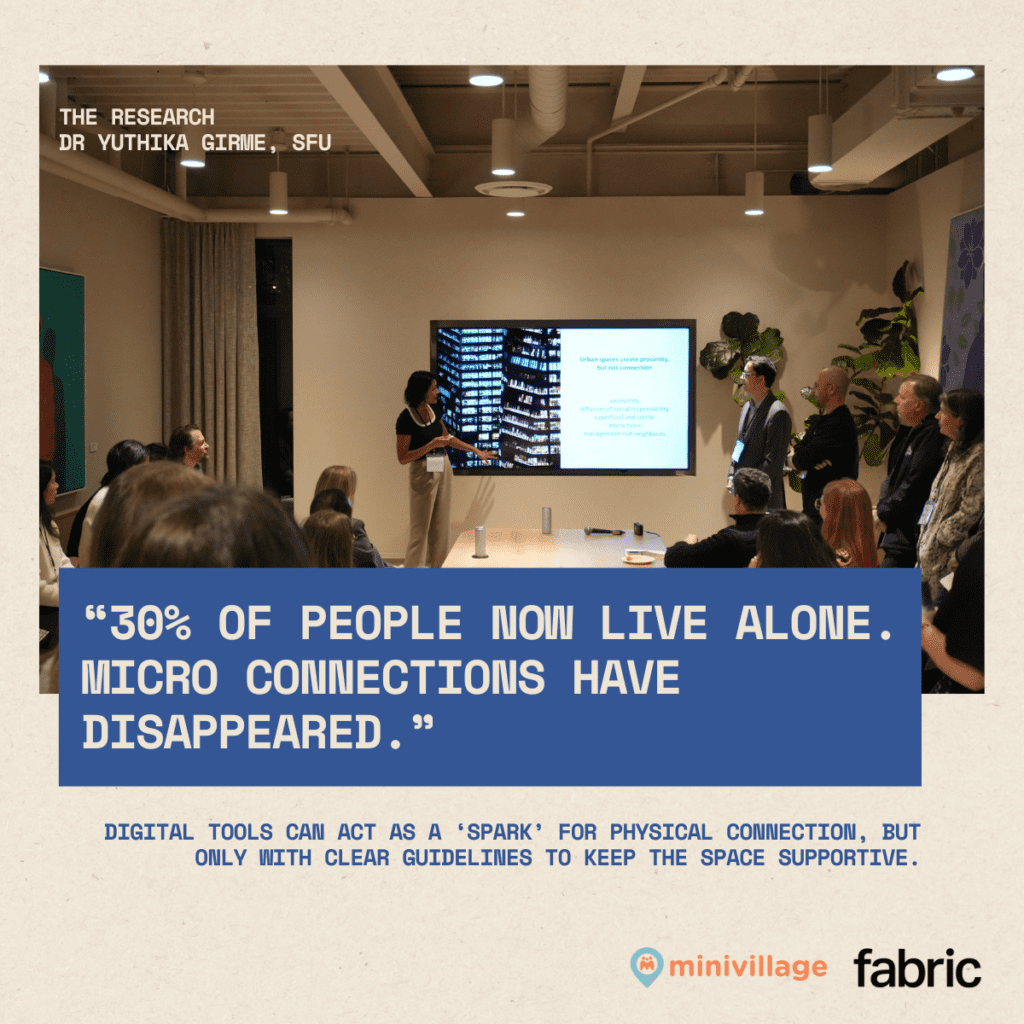
Dr. Yuthika Girme, Associate Professor of Psychology and Director of the SECURE Lab at SFU, shared compelling research on modern loneliness.
In the 1950s, only 7% of people lived alone. Today, that number has climbed to 30%. Despite living in dense urban environments, our “micro-connections” – casual interactions with neighbours, baristas, or fellow residents – have declined. Nearly a quarter of people report feeling lonely at least three days a week.
There’s a contradiction at play: people live in buildings full of other people, yet interactions often feel sterile or forced. The opportunity for connection exists – elevators, hallways, lounges – but what’s missing is a spark.
The Power of a “Spark”
In an experiment led by graduate researcher Victoria Martins Mendonca, a Slack channel was created for her own apartment building. Within a year, 20–30% of residents joined. People initially came for practical reasons – quick information, updates – but something more meaningful emerged.
Digital interactions spilled into the physical world: rooftop gatherings, holiday events, reciprocal acts of kindness. Residents reported feeling more empowered to support one another and a deeper sense of belonging.
But there’s an important caveat: unmanaged digital spaces can quickly become outlets for frustration. Without clear guidelines and thoughtful moderation, community apps can turn toxic. Technology alone doesn’t create connection, it simply amplifies the culture that’s already there.
Community Through Persistence, Not Programming
At fabric’s Hamilton Bank Building, community didn’t begin with a master plan. It started with a key.
When fabric partnered with Minivillage and resident artist Kate MacDonald as Community Coordinator, an unused unit was repurposed into a simple gathering space – a TV, projector, a few tables and chairs. Small, imperfect, but enough to begin.
What followed offers a blueprint for real community-building.
1. Predictable, Low-Pressure Gatherings
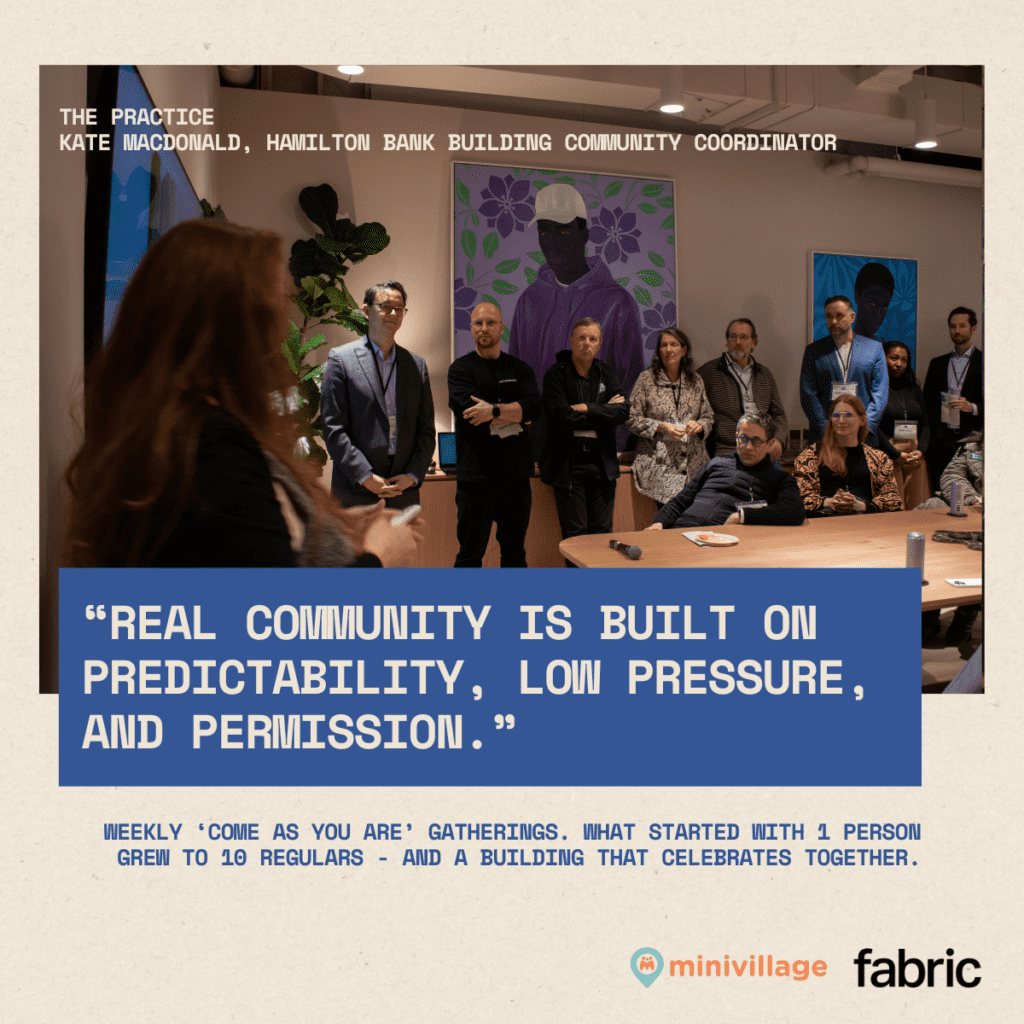
Every Thursday at 7pm. Optional. “Come as you are. Stay as long as you like.”
This consistency proved critical. What started as one person grew to ten regular attendees, with others popping in casually. The predictability removed social friction. The low pressure removed anxiety.
2. Creating Connections, Not Events
Initially, Kate facilitated coffee chats and collaborative art projects. But over time, something shifted. Residents began organizing holiday dinners and celebrations themselves.
The culture moved from attending events to creating shared memories.
That shift – from consumption to co-creation – is where ownership begins.
3. Managing Homes, Not Units
A pest issue threatened to fracture the building. Fear and blame surfaced quickly.
Instead of issuing top-down directives, the building manager sat down with residents over coffee, alongside a pest control expert, to address concerns openly. Problems were resolved earlier. Trust was strengthened. The community emerged stronger than before.
This was more than property management, it was home stewardship.
4. Permission Changes Everything
Perhaps the most powerful insight: community didn’t happen simply because of personality. It happened because leadership gave permission.
Permission to use space.
Permission to gather.
Permission to knock on a neighbour’s door.
By offering a “green light” and modest resources, residents transformed from passive tenants into active caretakers.
Strategy Matters: Events and Apps Don’t Build Community
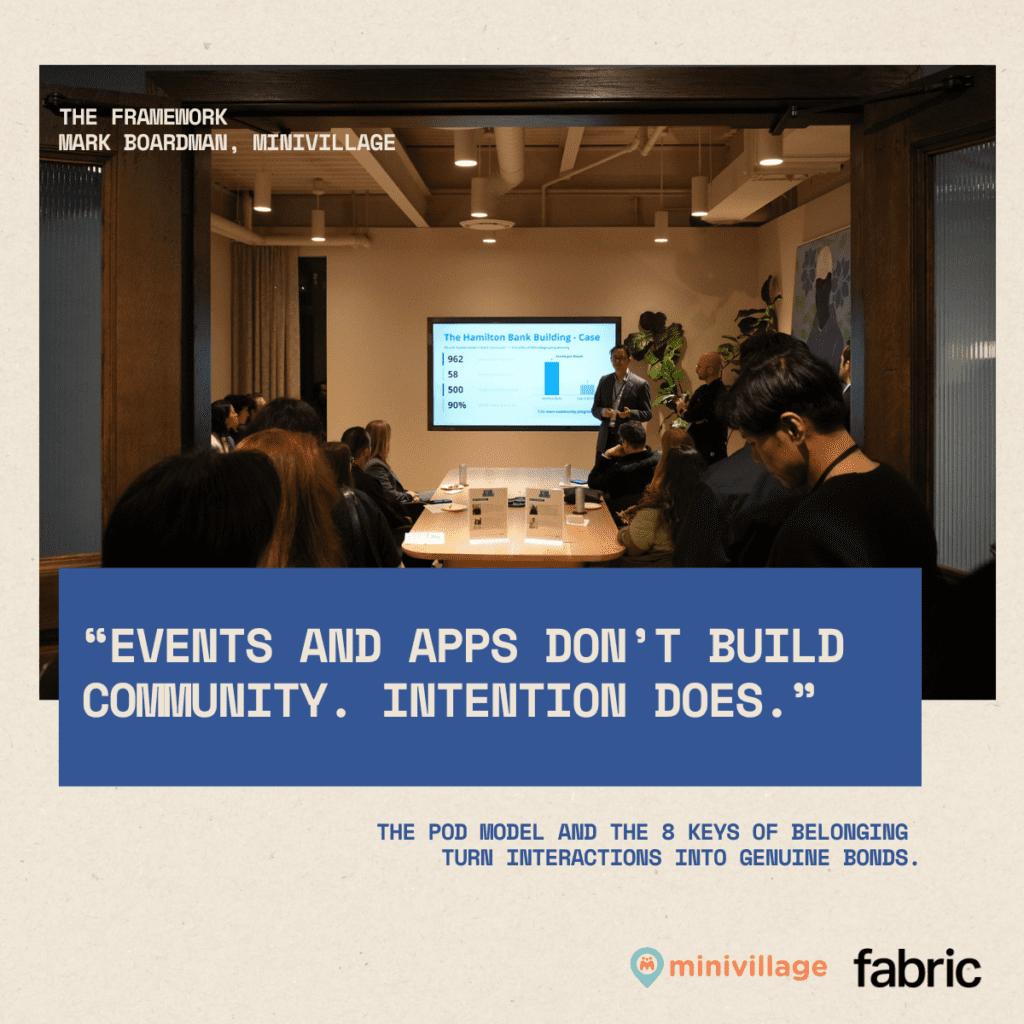
Mark Boardman, founder of Minivillage, emphasized a foundational truth: events and technology are tools – not solutions.
Simply putting people together doesn’t create bonds. In some cases, it can even increase friction. Intentional structure matters.
The Pod Model
Minivillage uses an evidence-based framework built around “pods” and the 8 Keys of Belonging. An ideal pod includes one coordinator (like Kate) and four to five additional volunteers. The recommended ratio: one pod per 50 residents.
This structure ensures that connection isn’t left to chance, it’s nurtured at a human scale.

A Triple Bottom Line Win
From a business perspective, the results were tangible.
Before investing in community-building, the Hamilton Bank Building struggled with vacancy, elevated operating costs, and negative culture. Within four months of partnering with Minivillage, the vibe shifted. The building felt friendlier, retention improved and vacancy decreased.
Investing in social health proved to be more than a “nice-to-have.” It delivered across the triple bottom line:
- People: stronger social bonds and belonging
- Purpose: homes, not just units
- Profit: lower vacancy, greater retention and reduced friction
Beyond Buildings
The takeaway is simple but powerful: community is infrastructure.
It requires intention, consistency, permission, and structure. But compared to capital upgrades or major renovations, it is relatively low-cost – and high-impact.
In an era where 30% of people live alone and loneliness is rising, buildings have an opportunity to become more than places to sleep. They can become ecosystems of support.
The future of residential real estate may not just be about better buildings.
It may be about building belonging.